


Security architect
The cybersecurity architect is the expert who acts as the authority on the technical and methodological security choices for IT systems. They apply models that match the strategies defined. They are a planner who makes sure that cybersecurity actions are fully compliant.
- Why is the security architect essential?
- What is a security architect?
- Main duties of the security architect
- A typical day as a security architect
- 5. Which training to become a security architect?
- 7. Career prospects
- 8. Why is this job in high demand?
- Security architect or cybersecurity administrator: what’s the difference?
- 9. FAQ: answers to students’ common questions
- Level of educationBac+5
- EmployabilityVery good
- Starting salary€5,000
- Experienced salary€7,000
- MobilityGood
- ROME codeM1802
- FAP codeM2Z
Why is the security architect essential?
The security architect plays a strategic role in protecting companies’ IT infrastructure. At a time when cyber threats are multiplying and becoming increasingly sophisticated, a security architect designs systems that can prevent, detect and counter these threats. The job is therefore indispensable to guarantee the security of sensitive data and keep companies’ business running.
What is a security architect?
The security architect is a professional who designs and implements secure IT infrastructure. They assess security risks, define suitable protection strategies and oversee the implementation of solutions. They work on both technical aspects (network protection, access management, etc.) and organisational aspects (setting up security policies).
Main duties of the security architect
Here are the security architect’s essential duties:
- Risk assessment: identifying potential threats and assessing the vulnerabilities of IT systems.
- Designing secure architectures: defining the architecture of systems while taking requirements into account.
- Implementation: overseeing the implementation of security solutions, coordinating the technical teams and validating installations.
- Compliance management: making sure that infrastructures meet security standards and regulations (ISO, GDPR, etc.).
- Technology watch: following developments in cyber threats and new technologies to propose innovative solutions.
- Training and awareness: training internal teams in good security practice and raising awareness of risks.
4. Essential skills to become a security architect
To excel as a security architect, several skills are needed:
Technical skills:
- Command of security systems (firewalls, antivirus, intrusion detection systems).
- Knowledge of network protocols (TCP/IP, VPN, HTTPS).
- Expertise in cryptography and key management.
- Knowledge of standards and regulations (ISO 27001, GDPR, etc.).
- Command of identity and access management (IAM) tools.
- Skills in risk management and threat analysis.
Personal qualities:
- Analytical and synthesis skills.
- Excellent communication skills to work with technical and non-technical teams.
- Ability to anticipate threats and propose innovative solutions.
- Rigour and organisation to meet deadlines and security requirements.
A typical day as a security architect
- MorningThey review a new project with the teams involved, covering needs, the data handled and regulatory constraints, then assess the risks and vulnerabilities of the proposed architecture.
- Late morningThey design or update a secure architecture: network segmentation, choice of firewalls and intrusion detection systems, identity and access management, and encryption of data flows.
- AfternoonThey oversee the implementation with the technical teams, answer their questions, approve the installations and check that they comply with the relevant standards and internal security policies.
- End of the dayThey write up architecture documents and recommendations, prepare an awareness session on good security practice for internal teams and spend time keeping up with new threats and technologies.
The pace picks up ahead of a go-live or an audit: they review technical choices, settle any gaps and support the teams until final approval.
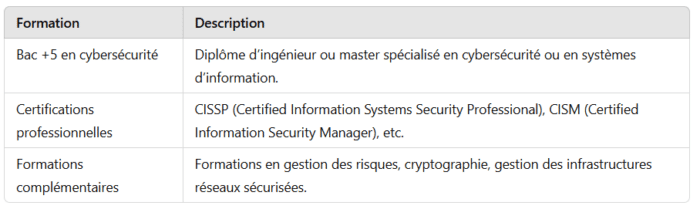
5. Which training to become a security architect?
Here is a table of the training needed to become a security architect (in French):
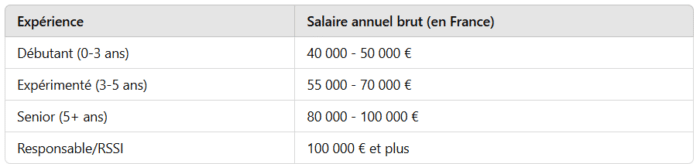
6. What is the salary of a security architect?
The salary of a security architect varies with experience, location and company.
7. Career prospects
The security architect can move on to several key roles in cybersecurity:
- Chief information security officer (CISO): in charge of the company’s overall security.
- Senior consultant: external expertise for a range of companies, in particular to set up tailored security strategies.
- Head of security in a large company: managing the cybersecurity team and large-scale security projects.
8. Why is this job in high demand?
With cyberattacks on the rise and companies becoming ever more digital, demand for professionals who can protect IT infrastructure is stronger than ever. Security architects are indispensable to prevent risks, ensure regulatory compliance and meet security challenges in a complex digital environment.
Security architect or cybersecurity administrator: what’s the difference?
The architect designs the protections that the administrator puts in place and maintains day to day:
| Security architect | Cybersecurity administrator | |
|---|---|---|
| Role | Design security architectures suited to the risks | Deploy and maintain security tools |
| Day to day | Risk analysis, design, approval of installations | Configuration, updates, access management |
| Tools | Firewalls, intrusion detection, IAM, cryptography | Firewalls, VPN, EDR, directories |
| Pace | Project-driven, busier ahead of go-lives | Office hours, possible on-call duty |
9. FAQ: answers to students’ common questions
What studies do you need to become a security architect?
A Bac+5 in IT, specialising in cybersecurity or information systems, is often required. Certifications such as CISSP or CISM can also strengthen your profile.
Can you work remotely as a security architect?
Yes, many companies offer remote working options, especially for consulting or audit assignments, although some tasks require being on site.
What is the difference between a security architect and a security engineer?
The security architect focuses on designing and implementing security solutions, while the security engineer deploys and manages security systems day to day.
What are the main threats a security architect must face?
Security architects must prepare for ransomware attacks, data breaches, DDoS attacks and insider threats.
Find out more

Description of the profession in the ANSSI directory
The information systems security architect makes sure that the technical and technological choices of IT and business projects meet the organisation's security requirements. They are the technical authority on security architectures, define security models and support the development of security architectures within the information system, in line with the organisation's IT strategy and security policies.
Read moreHow to access into the job?
Employers generally recommend a Bac+5 scientific degree with a specialisation in cybersecurity. They also expect proven experience in the technical architecture of information systems.
Bac+5 Cybersecurity Manager
This programme is designed for positions of responsibility and for highly specific cybersecurity needs. It lets you deepen and refine your knowledge and skills to manage an organisation’s cybersecurity.
The complete career guide
Condimentum lacinia quis vel eros donec ac odio. Nibh cras pulvinar mattis nunc sed blandit libero volutpat. Facilisis gravida neque convallis a cras semper auctor neque vitae.
Access the guide

Same field jobs
Our school provides training in 21 cybersecurity jobs, from technical to supervising positions, from IT operations to industrial systems security. Here is the list of jobs you will be trained for by attending one of our training programs.
Discover more jobs