


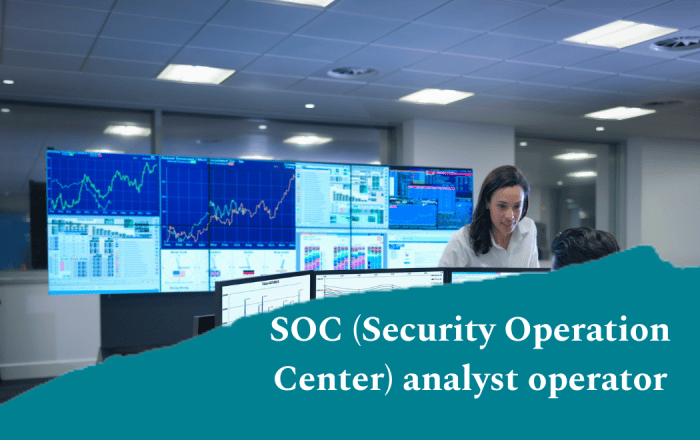
SOC (Security Operation Center) analyst operator
The SOC analyst operator monitors the organisation's information system in order to detect suspicious or malicious activity. They identify, categorise, analyse and qualify security events in real time or asynchronously, based on threat analysis reports. They help handle confirmed security incidents in support of the security incident response teams.
- Why the SOC analyst operator matters
- What is a SOC analyst operator?
- The SOC analyst job on video
- Main duties of the SOC analyst operator
- A typical day as a SOC analyst operator
- Essential skills to become a SOC analyst operator
- Which training to become a SOC analyst operator?
- What is the salary of a SOC analyst operator?
- Career prospects for a SOC analyst operator
- Why is this job in high demand?
- SOC analyst operator or cybersecurity analyst: what’s the difference?
- FAQ about the SOC analyst operator job
- Level of educationBac+3
- EmployabilityHigh
- Starting salary€2,900
- Experienced salary€4,000
- MobilityVery good
- ROME codeM1802
- FAP codeM2Z
Why the SOC analyst operator matters
With cyberattacks multiplying, the SOC analyst operator plays an essential role in protecting information systems. These professionals are on the front line, detecting and reacting quickly to IT threats, keeping data secure and business running.
What is a SOC analyst operator?
A SOC (Security Operation Center) analyst operator is a cybersecurity expert who works within a SOC, the nerve centre where security operations are centralised. Their main role is to monitor information systems continuously in order to identify and react to any suspicious activity.
The SOC analyst job on video
Main duties of the SOC analyst operator
Real-time monitoring: using tools such as SIEM (Security Information and Event Management) to detect anomalies.
Incident analysis: identifying where threats come from and assessing their potential impact.
Coordinating responses: working with other teams to contain and neutralise cyberattacks.
Reports and recommendations: documenting incidents and proposing preventive measures.
Continuous improvement: helping to optimise security procedures.
A typical day as a SOC analyst operator
- MorningThey take over from the previous team: they read the handover notes, check that log sources are reaching the SIEM properly and review pending alerts.
- Late morningThey triage alerts one by one: they rule out false positives, trace the origin of suspicious events and assess their potential impact on the systems concerned.
- AfternoonThey handle a confirmed incident: they document the facts, escalate according to procedure and work with other teams to contain the threat, for example by isolating a compromised workstation.
- End of the dayThey write reports on the incidents handled, suggest prevention measures and improvements to detection rules, then prepare the handover for the next team.
SOCs often run around the clock: depending on the rota, they work days, nights or weekends. A large-scale attack floods the console with alerts and calls for quick prioritisation.
Essential skills to become a SOC analyst operator
Technical skills
- Command of SIEM tools (Splunk, QRadar, etc.).
- In-depth knowledge of cyberattacks (phishing, ransomware, DDoS).
- Understanding of network architectures and protocols.
Soft skills
- Responsiveness: the ability to act quickly when facing a threat.
- Analytical mind: the ability to interpret complex data.
- Teamwork: working effectively with other cybersecurity experts.
Which training to become a SOC analyst operator?
Academic paths
- Bac+2/3: BTS SIO, BUT in IT, or a professional bachelor’s degree in cybersecurity.
- Bac+5: university master’s degree in cybersecurity or an engineering degree.
Key certifications
| Certification | Description |
|---|---|
| CompTIA Security+ | Introduction to security concepts. |
| CISSP | Advanced security expertise. |
| CEH (Certified Ethical Hacker) | Ethical hacking techniques. |
What is the salary of a SOC analyst operator?
| Experience level | Gross annual salary |
| Beginner | €30,000 to €40,000 |
| Experienced | €40,000 to €55,000 |
| Expert | €55,000 to €70,000 |
Career prospects for a SOC analyst operator
Senior SOC analyst: specialising in in-depth analysis.
Cybersecurity consultant: advice and audits for a range of companies.
SOC manager: supervision and team management.
Why is this job in high demand?
With cyber threats on the rise, companies are investing heavily in cybersecurity. SOCs play a central role, making the SOC analyst operator a much sought-after profile.
SOC analyst operator or cybersecurity analyst: what’s the difference?
Both roles analyse security alerts, but their scope is different:
| SOC analyst | Cybersecurity analyst | |
|---|---|---|
| Role | Monitor continuously and respond to security alerts | Monitor, analyse and strengthen the protection of systems |
| Day to day | Alert triage, escalation, incident reports | Log analysis, vulnerability management, incident response |
| Tools | SIEM, EDR, incident tracking tools | SIEM, vulnerability scanners, monitoring tools |
| Pace | Often shift-based, sometimes outside office hours | Office hours, called on during incidents |
FAQ about the SOC analyst operator job
What is the difference between a SOC operator and a security analyst?
A SOC operator specialises in monitoring and responding to incidents, while an analyst may have a broader role that includes designing strategies.
Can you do this job without a degree?
With a recognised certification and hands-on experience, it is possible to start a career in a SOC.
How long does it take to become a SOC analyst?
On average, 2 to 5 years of training and experience.
What are the working hours in a SOC?
SOCs often operate 24/7, which means shift work.
Description of the profession in the ANSSI directory
The SOC operator may need to develop machine learning skills in order to strengthen detection capabilities.
Read moreHow to access into the job?
Education: Bac+3, including a specialisation in cybersecurity Job accessible after a first experience in network and systems engineering
Bachelor in Cybersecurity – Cybersecurity Specialist (Bac+3)
The ideal path into the technical professions of cybersecurity. Bridges exist for people who have already completed IT-related programmes (BTS in IT, IUT in IT...) as well as for those from backgrounds wrongly seen as “far removed” from cyber (law degree, IAE business school...).
The complete career guide
Condimentum lacinia quis vel eros donec ac odio. Nibh cras pulvinar mattis nunc sed blandit libero volutpat. Facilisis gravida neque convallis a cras semper auctor neque vitae.
Access the guide

Same field jobs
Our school provides training in 21 cybersecurity jobs, from technical to supervising positions, from IT operations to industrial systems security. Here is the list of jobs you will be trained for by attending one of our training programs.
Discover more jobs